Your brain is about 1.4 kilograms of cells that talk to each other with
electricity and chemistry. This lab takes it apart — and then shows you the part almost
nobody is taught: your gut has a nervous system too, and it is doing most of the
talking.
你的大脑约重 1.4 公斤,由用电和化学物质互相交流的细胞组成。这个实验室会把它拆开看——
然后讲一个几乎没人教过的部分:你的肠道也有神经系统,而且大部分话都是它在说。
Work in this order: learn the words, watch the
overview, then open the machines and say what you see. Everything on this page is
meant to be said out loud.
按这个顺序:先学词,再看视频,然后打开机器,把你看到的说出来。这一页所有内容都是用来大声说的。
🔤 The words you need
Summary
Twenty-four terms this lab uses, each with a short definition, a longer explanation, and one sentence to say aloud. Learn these first, because every lesson below leans on them constantly.
Twenty-four words. Tap 🔊 say it to hear one, and 📖 tell me more
for the real explanation. Learn these first — the rest of the page uses them constantly.
二十四个词。点“🔊 say it”听发音,点“📖 tell me more”看真正的解释。先学会这些,
后面整页都在用它们。
🎤 Speaking drill
Five words at a time. Press the mic, say all five in any order, then check.
一次五个词。按下麦克风,任意顺序说出这五个词,然后检查。
listening
what you say appears here…
🎬 The whole picture — about four minutes, English + 中文 subtitles
Summary
An explainer of about four minutes, running from a single cell all the way to the gut-brain loop. The narration is synthetic, and every illustration in it was drawn or generated rather than photographed.
Watch this before you open the machines. It walks from one cell all the way
to the gut-brain loop, so the lessons below have somewhere to land.
先看这个再打开下面的机器。它从一个细胞一路讲到肠脑回路,
这样下面的课程才有落脚点。
An explainer, about four minutes. A computer reads the words. It is not
a person. Every picture in it was made by a computer too, not photographed. There is a
reason for that. You cannot photograph a neuron the way you photograph a bone. So the
pictures are drawings, and they say so. Subtitles in English and Chinese are
in the player's own controls. Treat the video as a summary of this page, not as a source.
这段解说是合成语音,不是真人;其中每一张插图都是生成的,而非拍摄的。
神经元无法像骨头那样被拍下来,所以这些图就是示意图。字幕在播放器控件里。
请把视频当作本页的摘要,而不是资料来源。
🔬 How the brain works
Six machines. Drag the sliders, click the diagrams, break things.
Then say what you see in English.
六台机器。拖动滑块,点击图示,随便弄。然后用英语说出你看到的。
🔎 One cell, three jobs
Summary
A neuron has three working parts. Dendrites collect the signals coming in. The cell body adds them up. The axon carries the answer away. The cell fires only when enough inputs arrive close together in time, because the charge leaks away between them.
No single synapse can fire this cell. One input moves it only a few
millivolts, and it needs fifteen. It fires only when enough inputs arrive
together. Several can arrive at the same moment. That is spatial
summation. Or several can arrive one after another, before the charge leaks away.
That is temporal summation. Click three green synapses slowly and watch it
fail. Click the same three quickly and watch it fire. A neuron is not a wire that
passes signals along. It is a cell taking a vote — and the vote expires.
没有任何单个突触能让这个细胞放电——一次输入只能把电位推高几毫伏,
而它需要十五毫伏。只有足够多的输入同时到达时它才会放电:
要么多个同时发生(空间总和),要么在电荷漏掉之前接连发生(时间总和)。
慢慢点击三个绿色突触,看它失败;再快速点击同样的三个,看它放电。
神经元不是一根传递信号的电线——它是一个正在投票的细胞,而且这张票会过期。
Neurons are not the only cells in there
Roughly half the cells in your brain are glia, not neurons.
They make the myelin. They clean up waste. They feed the neurons, and they cut away
connections nobody uses. For a century, scientists called them packing material.
They were wrong.
你大脑中约有一半细胞是神经胶质细胞,而不是神经元。它们制造髓鞘、清理废物、
为神经元提供营养、修剪无用的连接。它们曾被当作“填充物”整整一个世纪,其实并不是。
Why a dendrite looks like a tree
The diagram above draws the dendrites as a few simple lines. A real one
is not simple. It splits, and each branch splits again, and those branches split too.
The same shape keeps repeating at smaller and smaller sizes. A shape that does that has
a name. It is a fractal.
There is a reason for the shape. The cell has to collect signals from thousands
of other cells. Branching packs an enormous collecting surface into a very small space.
Nature reuses this trick everywhere — in ferns, in lightning, in river deltas — because
the problem keeps coming back. If you want to see that, and build fractals yourself,
this site has a whole lesson on them: Fractals — one rule, run
again and again. Come back here afterwards and look at the drawing below again.
上面的图把树突画成几条简单的线条,真实的树突并不简单。
它分叉,每个分支再分叉,那些分支又继续分叉。同样的形状在越来越小的尺度上不断重复。
这样的形状有一个名字:分形。
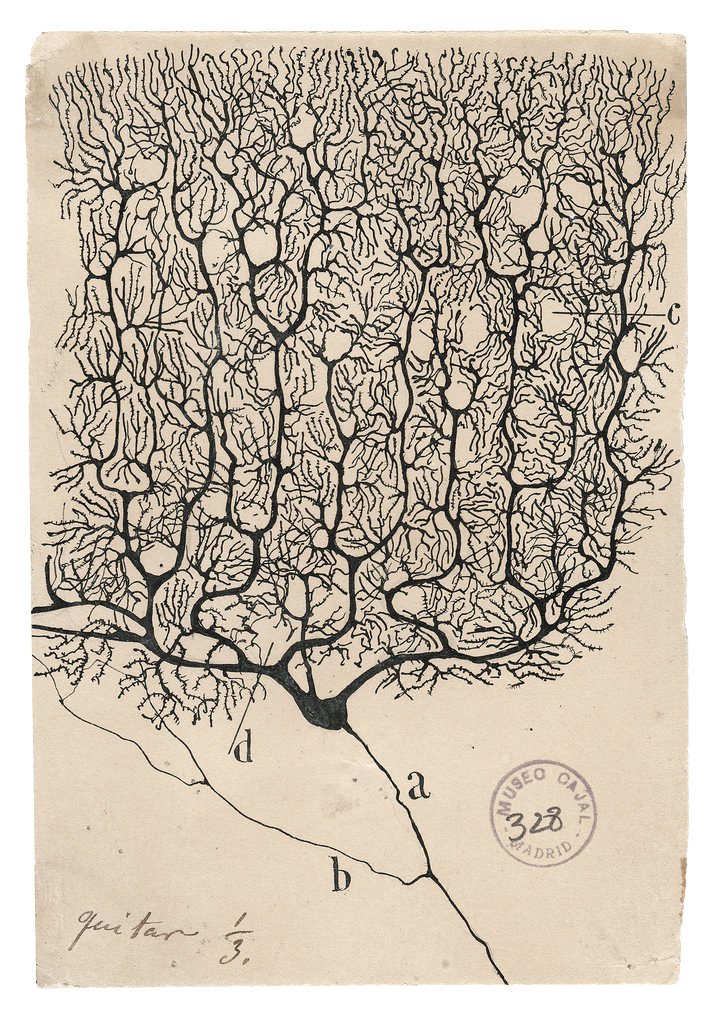
This is a real neuron, drawn by hand from a real microscope. Santiago
Ramón y Cajal drew this Purkinje cell from a human cerebellum, well over a hundred
years ago. You are looking at his actual sheet of paper — the round stamp in the corner
is the Cajal Museum in Madrid. The single thin line leaving the bottom is the
axon, marked a. Everything above the cell body is one set of
dendrites, belonging to that one cell. Count the levels of branching. That is
what "fractal" means, and this drawing is the evidence for it.
这是一个真实的神经元,由人手对着显微镜画下。
圣地亚哥·拉蒙-卡哈尔在一百多年前画下了这个来自人类小脑的浦肯野细胞。
你看到的就是他本人的那张纸——角落里的圆形印章是马德里的卡哈尔博物馆。
从底部伸出的那条细线是轴突(标记为 a)。
胞体以上的全部结构,都是这一个细胞的树突。数一数分叉的层数——这就是“分形”的含义。Santiago Ramón y Cajal — public domain, Cajal Institute (CSIC),
Madrid, via Wikimedia Commons.
🔋 What is voltage?
Summary
Voltage is a difference between two points. It is never a value at one place on its own. Inside a resting neuron, the voltage sits about seventy thousandths of a volt below the outside. The minus sign only records which side we chose as zero. The voltage moves when charged particles cross the membrane.
The rest of this lab keeps saying “minus seventy millivolts”. Three things
must be clear before that means anything. What voltage is. How it can be
negative. And what it is negative compared to.
本课其余部分一直在说“负七十毫伏”。要理解它,必须先弄清三件事:
电压是什么、它怎么会是负的、以及它是相对于什么为负。
About that meter. It has two probes. It can only report the
difference between them. It can never give a number for one place on its own. So
to get a single number, you must call one probe zero. The reading then tells
you where the other probe sits.
The two buttons below choose which side that zero sits on. This is a
measuring choice, not a change to the cell. No ion moves when you press either
one. The highlighted button is the one in use now.
关于这个电表。它有两个探头,只能报告两者之间的差值,
永远无法单独给出某一处的数值。要得到一个数字,你必须先指定其中一个探头为零点,
读数则告诉你另一个探头相对于它处在什么位置。
You cannot ask “what is the voltage here?” It is like asking “how high
is this?” without saying above what. Height is always measured from
somewhere — the floor, the sea, the ground outside. Voltage works the same way. It is
always between two points. It measures how hard electric charge would be pushed
from one point to the other, if you let it move. A single point has no voltage.
你不能问“这里的电压是多少”,就像你不能不说“高于什么”就问“这有多高”。
高度总要从某处量起——地板、海平面、屋外的地面。电压也一样:它永远是两点之间的量,
衡量的是如果允许电荷移动,它会被推得多用力。单独一个点本身没有电压。
2 · That is why it can be negative
Negative does not mean “less than nothing”. It means the other
direction — like a temperature below zero, or three metres below sea level.
Someone has to choose which point counts as zero. In neuroscience, everyone agrees to
put zero on the outside of the cell. So “−70 mV” is short for this: the inside
is 70 thousandths of a volt lower than the outside.
Think of measuring a table. Put your zero on the floor and the tabletop is
+75 cm. Put your zero on the tabletop and the floor is −75 cm. Same table,
same gap, opposite sign — you only changed where you measured from.
Press Measure on the inside above. The number becomes +70.
Nothing about the cell changed. The minus sign is bookkeeping, not biology.
负数不表示“比没有还少”,它表示相反的方向——就像零度以下的气温,
或海平面以下三米。总得有人选定哪一点算作零,而在神经科学中,大家一致把零点放在细胞
外侧。所以“−70 毫伏”的意思是:细胞内部比外部低千分之七十伏。
Of one cell. The membrane is the boundary. It is a fatty film
about five nanometres thick. Stack ten thousand of them and you barely match one
sheet of paper. There is salt water on both sides, full of charged particles.
“Inside” is the fluid in that one neuron. “Outside” is the fluid around it.
Here is the surprising part. Both fluids are almost perfectly
neutral. The extra charge sits in a very thin film against each
face of the membrane. Almost no ions have to move to make 70 millivolts. Fewer than
one ion in a hundred thousand.
是一个细胞的内外。细胞膜就是边界——一层约五纳米厚的脂质薄膜,
薄到一万层叠起来才勉强抵得上一张纸。两侧都是充满带电粒子的盐水。
“内”是这一个神经元里的液体,“外”是浸泡着它的液体。
4 · So is there voltage inside and outside my body?
Yes — and you can measure it. Every one of your cells holds a voltage across its own
membrane right now. When millions of heart-muscle cells fire together, the difference
reaches your skin. That is exactly what an ECG records: about a
thousandth of a volt between two sticky pads. An EEG reads your brain the
same way, at roughly a millionth of a volt. These machines add no electricity to
you. They only listen.
But your body as a whole has no voltage “of its own”. The same rule applies. It
is only ever a difference against something else. Rub your feet across a carpet and you
can sit at thousands of volts compared with a doorknob. That sounds deadly, but it
is not. Voltage is only the push. There is almost no charge behind it, so the spark ends
in microseconds. Mains electricity is a much lower voltage and far more dangerous. It can
keep pushing charge through you all day.
4 · 那我的身体内外有电压吗?有——而且可以测量。此刻你的每个细胞都在
自己的膜上维持着电压。当数百万心肌细胞同步放电时,这个差值会传到皮肤,
而心电图(ECG)记录的正是它:两片electrode之间约千分之一伏。
脑电图(EEG)以同样方式读取大脑,约为百万分之一伏。
这些仪器不会给你通电,它们只是倾听。
Charged particles crossing the membrane — nothing else. They are called
ions: sodium (Na⁺) and potassium (K⁺) both carry one positive charge.
Sodium is piled up outside the cell. Potassium is piled up inside.
Two things push each ion at the same time. It drifts from where it is crowded toward
where it is not. And it is pulled toward opposite charge. The membrane blocks them
all — until a channel opens. A channel is a door. Each door lets only one
kind of ion through.
So the rule fits in one line. The voltage moves toward
whatever the open door's ion wants. Open the sodium door and positive charge floods
in, so the inside climbs toward +60 mV. Open the potassium door and
positive charge leaves, so the inside falls toward −90 mV. Try both buttons above
and watch the needle chase a different target each time.
是带电粒子穿过细胞膜——仅此而已。它们叫离子:
钠(Na⁺)和钾(K⁺)各带一个正电荷。
Two machines, working on completely different timescales.
The pump charges the battery, slowly and constantly. A protein called the
sodium-potassium pump burns ATP. It pushes three sodium ions out for every two potassium
ions it pulls in. It runs every second of your life and never stops. That is most of
the reason your brain eats about a fifth of your energy. The pump does not make the
voltage directly. It stacks sodium outside and potassium inside, storing the gradients.
The channels discharge it, fast and selectively. At rest, a few potassium
doors sit open. Potassium trickles out down its gradient. It carries positive charge
away and leaves the inside negative. But it does not all leave. As the inside
grows more negative, it starts pulling the positive potassium back. At about −90 mV
the two pulls balance exactly. That balance point is why the
resting voltage sits where it does.
And then the trick. Some doors are opened by voltage itself. Push
the membrane up a little and sodium doors open. Sodium rushes in and pushes it higher,
which opens more doors. That runaway is the spike in the next lesson. It is also why a
neuron has a threshold rather than a dial.
两台机器,运行在完全不同的时间尺度上。
Each ion has its own balance point, called its equilibrium
potential. Its concentration difference sets it, and nothing else. Sodium is roughly
twelve times more concentrated outside than in. So it keeps flowing inward until the
inside reaches about +60 mV — positive enough to push any more sodium back out.
Potassium is about thirty times more concentrated inside. So it flows outward until the
inside hits about −90 mV — negative enough to hold the rest of it in.
The real membrane voltage always sits between those two numbers. It sits
nearer to whichever ion has more doors open. At rest that is potassium. That is
why −70 mV is much closer to −90 than to +60.
每种离子都有自己的平衡点,称为平衡电位,完全由其浓度差的悬殊程度决定。
钠在细胞外的浓度约为细胞内的十二倍,因此它会持续内流,直到内部达到约 +60 毫伏——
正到足以把后续的钠推回去。钾在细胞内的浓度约为外部的三十倍,因此它外流至内部约
−90 毫伏——负到足以把其余的钾留住。
At about minus fifty-five millivolts the sodium gates snap open and the cell fires. The spike is all or nothing, and always the same size. So a neuron signals something stronger by firing more often, not harder. In the fastest myelinated fibres it travels up to a hundred and twenty metres per second.
Drag the slider slowly. The top graph is the voltage inside the cell; the
strip below is the membrane, with its gates opening and closing.
慢慢拖动滑块。上方是细胞内电压曲线,下方是细胞膜,可以看到闸门的开合。
membrane voltageNa⁺ gate (in)K⁺ gate (out)
All or nothing
A neuron cannot fire gently. Below the threshold nothing happens at
all. Above it, you always get the same full-size spike. So a neuron cannot shout
louder. To signal something stronger, it fires more often. That is the whole
vocabulary of a single cell: how fast, and when.
神经元无法“轻轻地”放电。低于阈值什么都不会发生,高于阈值则总是同样大小的完整脉冲。
所以它无法喊得更大声——要表示更强的信号,它只能放电得更频繁。
单个细胞的全部“词汇”就是:多快,以及什么时候。
Why is there a voltage at rest at all?
The membrane pumps sodium out and potassium in. Three sodium for every
two potassium, and it costs ATP. That imbalance leaves the inside about
70 millivolts negative compared with the outside. Your brain spends roughly a
fifth of your body's energy, mostly on holding that charge. It is a battery you pay
to keep charged, so that it can be emptied in a millisecond.
细胞膜把钠泵出、把钾泵入,每泵出三个钠就泵入两个钾,这需要消耗 ATP。
这种不平衡使细胞内部比外部低约70 毫伏。你的大脑消耗全身约五分之一的能量,
很大一部分就用在维持这个电荷上——一块你花钱维持充电、只为在一毫秒内放电的电池。
The refractory period — why signals only go one way
Straight after a spike the sodium gates are inactivated. They are
not shut and ready. They are jammed, and they will not reopen until the voltage falls
back. So the piece of membrane just behind the spike cannot fire again yet, and the
spike cannot run backwards. Direction is not built into the axon. You get it free,
because the gates are briefly out of order.
脉冲刚过去时,钠闸门处于失活状态:不是关好待命,而是卡住了,
必须等电压回落才能重新打开。因此脉冲后方的那段膜暂时无法再次放电,脉冲也就无法倒流。
方向性并不是轴突本身的结构决定的——它是闸门短暂“失灵”的免费副产品。
🔗 The gap
Summary
Neurons almost never touch. A gap of twenty to forty nanometres separates them. So the electrical signal turns into a chemical one, and then back again. Glutamate excites the next cell and GABA inhibits it. Most of what your brain does is a balance between those two.
Neurons mostly do not touch. Drag through what happens in the gap.
the gap is about 20–40 nm — a thousandth of the width of a hair神经元大多并不相互接触。拖动滑块,看看间隙中发生了什么。
Go and stop
Glutamate is the main accelerator. It makes the next neuron more
likely to fire. GABA is the main brake. Most of what your brain does, moment to
moment, is a balance between those two. Push it too far toward glutamate and
you get a seizure. Push it too far toward GABA and you lose consciousness. Anaesthetics
and alcohol both work mostly by helping GABA.
谷氨酸是主要的加速器,让下一个神经元更容易放电;γ-氨基丁酸(GABA)是主要的刹车。
大脑每时每刻做的大部分事情,就是在这两者之间取得平衡。太偏向谷氨酸会癫痫发作,太偏向 GABA 则会失去意识。
麻醉剂和酒精主要都是通过增强 GABA 起作用的。
Modulators — dopamine, serotonin, noradrenaline
These are different from glutamate and GABA. They mostly do not carry
the message. They set the terms the message arrives on. How strongly a circuit
responds. How much of what just happened gets learned. How urgent everything feels.
Popular writing calls dopamine "the pleasure chemical". It is closer to a
prediction-error signal. It spikes when something is better than expected. That
is why it drives learning and wanting, rather than enjoyment.
它们与谷氨酸和 GABA 不同:大多不负责传递信息,而是设定信息到达时的条件——
回路反应的强度、刚发生的事有多少会被学习下来、一切感觉有多紧迫。
流行说法把多巴胺称为“快乐分子”,但它更接近一种预测误差信号:
当结果比预期更好时它会飙升,所以它驱动的是学习和“想要”,而不是享受本身。
Where the drugs act
Almost every drug that changes how you feel acts somewhere in this
diagram. SSRIs block reuptake, so serotonin stays in the gap longer. Caffeine
blocks adenosine receptors, and removes a brake on alertness. Nicotine imitates
acetylcholine and fits its receptor directly. None of them add a feeling. They all
change the timing or the size of a signal that was already there.
几乎所有能改变你感受的药物都作用于这张图中的某处。SSRI 抑制再摄取,
让血清素在间隙中停留更久;咖啡因阻断腺苷受体,解除对清醒度的抑制;
尼古丁模仿乙酰胆碱,直接嵌入它的受体。它们都不会凭空增加一种感受,
只是改变了本来就存在的信号的时机或强度。
🗺️ The map
Summary
The hippocampus writes new memories. The amygdala flags a threat before you have recognised it. The prefrontal cortex holds a plan in mind and stops the impulse. But almost nothing has a single address. A region can be necessary for a job without doing that job alone.
A simple side view of the left hemisphere, facing left. Click a
region to name it. There are eighteen. The six large shapes are
the lobes and the cerebellum. The two strips across the top are motor and
touch. The two marked with white dashes are language areas. They sit on the lobes,
but they are not lobes themselves. The small solid shapes are deep structures
buried inside. The button under the map can hide those.
这是左半球的示意侧视图,面朝左。点击一个脑区——共有十八个,
点击即可看到名称。六个大形状是各脑叶和小脑;顶部两条条带分别是运动区和触觉区;
用白色虚线标出的两个是位于脑叶之上的语言区,而不是脑叶本身;
那些小的实心形状是埋在内部的深部结构,可以用图下方的按钮隐藏。
Careful with "the X area of the brain". Almost nothing has one address.
Language, memory and emotion are each spread over networks. And a region can be
necessary for a job without doing that job alone.
The map is a starting point, not the answer. The photograph below shows what the
map is hiding.
要小心“大脑的某某区”这种说法。几乎没有什么功能只有一个地址。
语言、记忆和情绪都分布在网络之中;某个脑区对一项功能是必需的,
并不等于这项功能是它独自完成的。这张图是起点,不是答案。
Why language sits on the left
In roughly ninety-five per cent of right-handed people, the
language areas sit on the left hemisphere. So do they in about seventy per
cent of left-handers. That is why a stroke on the left so often takes speech.
A stroke on the right, of the same size, may not touch it at all. Nobody fully
knows why language went to one side. But the difference appears early in
development, and you can see it in the anatomy. The matching patch of tissue is
measurably larger on the left.
约百分之九十五的右利手者语言区位于左半球,左利手者中也约有百分之七十如此。
这就是为什么左侧中风常常影响言语,而同样大小的右侧中风却可能完全不波及。
语言为何偏侧化,至今没有完全弄清,但这种不对称在发育早期就已出现,
而且在解剖结构上可见:左侧对应的那块组织确实更大。
The cable between them — and what happens if you cut it
The dashed line on the map is the arcuate fasciculus. It is
the bundle of fibres joining Wernicke's area to Broca's. Damage it, and leave both
ends healthy, and you get conduction aphasia. The person understands
perfectly. They speak fluently. But they cannot repeat what they just heard.
Understanding works. Producing works. Passing the message across does not.
That is this page's strongest argument against thinking in areas at all.
Two healthy regions and one broken wire produce a problem that belongs to
neither region.
图上的虚线是弓状束,连接韦尼克区与布若卡区的纤维束。
若两端完好而它受损,就会出现传导性失语:病人完全理解,也说得流利,
却无法复述刚听到的话。理解正常,产出正常,唯独把信息从一端传到另一端不行。
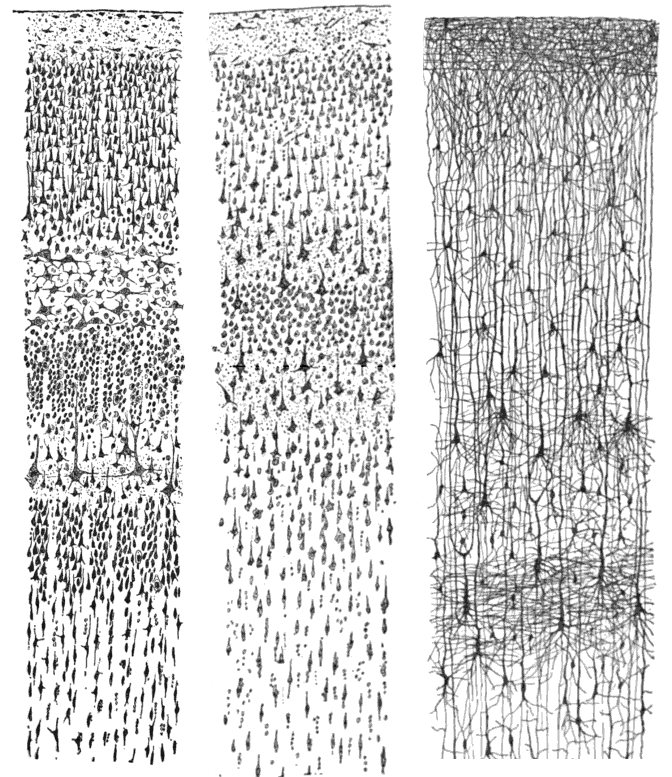
What a coloured region really contains. These are Cajal's own drawings
of human cortex. The two on the left are stained to show only the cell bodies, so
you can see the layers. The one on the right is stained differently. It shows a few
whole cells, branches and all. Both pictures are the same tissue. Remember that when
you click a coloured shape on the map above. Each block of colour holds millions of
cells like these, wired to millions more in other blocks.
一个彩色脑区里究竟有什么。这是卡哈尔亲手绘制的人类皮层。
左边两幅只染出细胞胞体,因此能看到分层。右边一幅用了不同的染色法,
显示出少数完整的细胞,连同全部分支。两幅画的是同一种组织。
点击上面地图中的彩色形状时,请记住这一点:每一块颜色里都有数以百万计这样的细胞,
并且连接着其他区块中的数百万个细胞。Santiago Ramón y Cajal, from Comparative study of the sensory
areas of the human cortex, 1899 — public domain, via Wikimedia Commons.
🌱 Use it or lose it
Summary
Connections you use often grow stronger. Connections you leave unused get weaker, and are finally cut away. That strengthening needs new proteins, and they take hours to build. So the same number of repetitions lasts far longer spread across days than crammed into one evening.
Drag the slider: how many times have these two neurons fired together?
拖动滑块:这两个神经元一起放电了多少次?
Neurons that fire together, wire together
When one neuron often helps fire another, the synapse between them
gets stronger. The receiving side grows more receptors. The sending side releases more
transmitter. That strengthening is called long-term potentiation. It is the
best physical answer we have to the question of what a memory is. The reverse
happens too. Connections nobody uses grow weaker, and glial cells finally cut them
away.
当一个神经元反复帮助另一个神经元放电时,它们之间的突触会变强——
接收端受体更多,发送端释放的递质更多。这种增强称为长时程增强(LTP),
它是目前对“记忆究竟是什么”最好的物理解释。反过来也一样:
闲置不用的连接会被削弱,最终被神经胶质细胞修剪掉。
Why practice has to be spaced out
Making a synapse permanently stronger needs new proteins, and building
them takes hours. Cramming fires the same circuit again and again inside one short
window. That strengthens it briefly, but leaves no time for the slow step. The same
number of repetitions spread across days produces a much stronger change. The
limit is not your willpower. It is protein synthesis.
让突触永久变强需要合成新的蛋白质,而这需要数小时。
临时抱佛脚是在一个时间窗内反复激活同一回路,能带来短暂增强,
却没有给缓慢的结构性变化留出时间。同样次数的重复分散到几天完成,
产生的改变要持久得多。限制你的不是意志力,而是蛋白质合成的速度。
Sleep is part of the mechanism, not a pause in it
During sleep, the hippocampus replays the day's sequences to the cortex
at speed. That is how a fragile new memory gets copied into a lasting one. Slow-wave
sleep also weakens synapses everywhere. That sounds destructive, but it raises the
signal-to-noise ratio. What survives the night is what was strongest. Lose a night's
sleep after learning and you lose much of the learning.
睡眠期间,海马体会以高速向皮层回放当天的序列,
脆弱的新记忆正是这样被复制成持久记忆的。慢波睡眠还会整体削弱突触,
这听起来像是破坏,实际上提高了信噪比:能熬过这一夜的,就是原本最强的那些。
学习之后如果缺一晚上的觉,学到的东西会损失大半。
🦠 The second brain
Summary
The wall of your intestine holds about five hundred million neurons. It can run digestion on its own, with the brain disconnected. The vagus nerve links the two. Most of its fibres carry information upward, so the gut reports far more than it is ordered. The link to mood is real, but serotonin made in the gut cannot reach the brain.
This is the part almost nobody is taught. Drag through one full loop:
gut → nerve → brain → back down again.
这是几乎没人教过的部分。拖动滑块走完一个完整回路:
肠道 → 神经 → 大脑 → 再回到肠道。
signals going up (gut → brain)signals coming down (brain → gut)
Your gut has its own nervous system
Woven through the wall of your intestine is the enteric nervous
system — about 500 million neurons, more than in a cat's whole
brain. It has its own sensory neurons, its own motor neurons and its own circuits. It
can run digestion by itself, even with the connection to the brain completely cut. That
independence earned it the nickname "the second brain". It is a real nervous
system, not a metaphor.
在你的肠壁中交织着肠神经系统——约有五亿个神经元,
比一整只猫的大脑还多。它有自己的感觉神经元、运动神经元和回路,
即使与大脑的连接被完全切断,它也能独立完成消化。
正是这种独立性让它得到了“第二大脑”的绰号。它是一个真正的神经系统,不是比喻。
The vagus nerve carries far more up than down
The vagus is the main cable between the two. The traffic is very
uneven. Roughly 80–90% of its fibres are afferent. They carry information
upward, from body to brain. Your gut reports far more than it
receives orders. That one fact reverses the direction most people assume.
迷走神经是两者之间的主干线,而它的“交通”是不对称的:
约80–90% 的纤维是传入纤维——把信息向上从身体送往大脑。
你的肠道向大脑汇报的,远多于它接收的指令。仅这一个事实,
就颠倒了大多数人以为的关系方向。
The bacteria join the conversation
You carry about a hundred trillion gut bacteria. Some of them
make the same molecules your neurons use — GABA, and the building blocks of dopamine and
serotonin. Others turn fibre into short-chain fatty acids such as butyrate.
Those feed the gut lining, calm inflammation, and even affect the blood-brain
barrier. The bacteria also push on the immune system, and immune signals reach the
brain too. So there are at least three routes up: the vagus nerve, the bloodstream, and
the immune system.
你体内约有一百万亿个肠道细菌。其中一些能制造与你的神经元相同的分子——
GABA,以及多巴胺和血清素的前体。另一些把膳食纤维发酵成短链脂肪酸(如丁酸),
它们滋养肠道内壁、抑制炎症,甚至影响血脑屏障本身。
它们还会作用于免疫系统,而免疫信号同样能到达大脑。
所以向上至少有三条通路:迷走神经、血液循环和免疫系统。
The serotonin number, read honestly. You will often see "90–95% of your serotonin
is made in the gut, not the brain". That is true. The conclusion usually drawn from it is
not. Serotonin made in the gut does not cross the blood-brain barrier — it cannot
get into your brain. It acts locally, on gut movement and on the vagal nerve endings that
report upward. So the gut genuinely influences mood, but not by posting serotonin to your
head. If a headline says otherwise, it has skipped a step.
关于血清素这个数字,请诚实地理解。你常会看到“你体内 90–95% 的血清素在肠道而非大脑中合成”。
这是真的,但人们从中得出的结论通常是错的。肠道合成的血清素无法穿过血脑屏障——
它进不了你的大脑。它只在局部起作用:影响肠道蠕动,以及作用于向上汇报的迷走神经末梢。
所以肠道确实会影响情绪,但不是靠把血清素“寄”到你脑子里。
如果哪个标题这么说,它一定跳过了一步。
The evidence: germ-free mice
Raise mice in a sterile bubble with no gut bacteria at all, and
their stress system develops wrongly. They over-react to mild stress. Their
brains also show changed levels of the growth factor BDNF in the hippocampus. Give the
bacteria back early enough in life and the stress response partly recovers. Do it too
late and it does not. This is the strongest evidence in the field. But be clear about
what it shows. It shows that gut bacteria are part of normal brain
development. It does not show that changing an adult's diet rebuilds their brain.
把小鼠养在完全无菌的环境中,它们的应激轴会发育异常——
对轻微压力反应过度,海马体中的生长因子 BDNF 水平也发生改变。
若在生命早期把细菌重新引入,应激反应可部分恢复正常;太晚就不行了。
这是该领域最有力的证据,但要说清楚它证明了什么:
肠道细菌是大脑正常发育的一部分。它并没有证明改变成年人的饮食就能重塑大脑。
The evidence: transplanting a temperament
Transfer gut bacteria from a bold mouse strain into a timid one, and
some of the boldness moves with it. Faecal transplants from people with depression
into rats have produced depression-like behaviour in the rats. These results are
striking, and they are real. They are also rodent results. Those animals are
bred to be genetically alike. They live in cages and eat identical food. Every
variable that makes humans messy has been removed.
把胆大品系小鼠的肠道细菌移植给胆小品系,部分“胆量”会随之转移。
将抑郁症患者的粪便移植到大鼠体内,大鼠会出现类似抑郁的行为。
这些结果确实惊人,也确实是真的。但它们同样是啮齿类的结果:
这些动物基因高度一致、生活在笼中、吃同样的食物——
所有让人类变得复杂的变量都被去掉了。
What actually holds up in humans
Three things are real and measured many times. Gut bacteria differ
between people with and without depression. The vagus carries gut state to regions
that matter for mood. And irritable bowel syndrome goes with anxiety far more
often than chance allows, in both directions. Weaker: specific probiotic strains as
treatments. Single trials look promising, but the effects are small and often fail to
replicate. The honest summary is short. The link is established. The
lever is not. Diet shifts mood a little. It is not a cure, and anyone selling
it as one is ahead of the evidence.
确实成立、且被反复测量到的:抑郁症患者与非患者的肠道菌群存在差异;
迷走神经会把肠道状态传递到与情绪相关的脑区;肠易激综合征与焦虑的共现率远高于随机,
而且是双向的。较弱的:把特定益生菌菌株当作治疗手段——个别试验看起来不错,
但效应量小,且常常无法重复。诚实的总结是:联系已经确立,可操作的杠杆还没有。
饮食能略微改变情绪,但它不是治疗;任何把它当作治疗来卖的人,都跑在证据前面了。
Why you feel it in your stomach
"Butterflies in the stomach" and "I had a gut feeling" are not just
poetry. When your brain sees a threat, signals travel down and
change gut blood flow and movement within seconds. Then the gut reports that
change back up. Part of what you feel as anxiety is your brain reading its own
orders coming back. The loop is the feeling. It is not a metaphor for it.
“胃里有蝴蝶”和“凭直觉(gut feeling)”并不是碰巧提到肠道的诗意说法。
当大脑察觉到威胁时,下行信号会在几秒内改变肠道的血流和蠕动——
而肠道随后又把这个变化向上汇报回来。
你体验到的焦虑,有一部分就是大脑读到了自己下达的指令绕回来的结果。
这个回路本身就是那种感受,而不是它的比喻。
📌 Points to Remember
The six things worth carrying out of this lab.
这个实验室里最值得记住的六点。
Voltage is a difference between two points. “−70 mV” means the inside sits
lower than the outside — and the minus sign is only a choice about where zero goes.
电压是两点之间的差值。“−70 毫伏”表示内部低于外部,
而负号只是零点选在哪里的问题。
A neuron cannot shout louder. Below the threshold nothing happens; above it
you always get the same full spike. To signal something stronger it fires more often.
神经元无法喊得更大声。低于阈值毫无反应,高于阈值总是同样的完整脉冲。
要表示更强的信号,它只能放电得更频繁。
It only fires when enough inputs arrive together. The charge leaks away, so
the same three signals can fire the cell when they are fast and fail when they are slow.
只有足够多的输入同时到达时它才会放电。电荷会漏掉,
所以同样的三个信号,快速到达能让细胞放电,缓慢到达就不行。
Neurons that fire together, wire together. Used connections are strengthened;
unused ones are weakened and eventually pruned away.
一起放电的神经元会连在一起。用到的连接会增强,
闲置的会被削弱并最终被修剪掉。
Your gut has its own nervous system — about 500 million neurons — and the
vagus nerve carries far more signals up than down. It reports more than it is ordered.
你的肠道有自己的神经系统——约五亿个神经元——
而迷走神经向上传的信号远多于向下传的。它汇报的比接收的指令多。
Gut serotonin does not reach the brain. The gut-brain link is real and
two-way, but the effect in humans is modest — anyone selling it as a cure is ahead of
the evidence.
肠道血清素无法到达大脑。肠脑联系真实存在且是双向的,
但它在人类身上的效应有限——任何把它当作治疗来卖的人,都跑在证据前面了。
Thank you for working through it —
and see you in the next lab.
感谢你完成这一课——我们下个实验室见。
🖼️ Picture credits
Two kinds of picture appear on this page, and they
are not the same thing. Every diagram is drawn by the page itself, in code, and every
illustration in the video was generated by a computer. The two drawings are neither.
Santiago Ramón y Cajal made them by hand, looking down a microscope, more than a hundred
years ago. They are not decoration. They are the historical evidence for what the diagrams
only sketch, and that is why they are here.
本页上有两类图像,它们并不相同。所有示意图都是页面用代码自己绘制的,
视频中的插图则由计算机生成。那两幅手绘两者都不是:
一百多年前,圣地亚哥·拉蒙-卡哈尔对着显微镜亲手画下了它们。
它们不是装饰,而是示意图所简化的那些结构的历史证据——这正是它们出现在这里的原因。
Santiago Ramón y Cajal, A Purkinje neuron from the human cerebellum — public
domain, Cajal Institute (CSIC), Madrid, via
Wikimedia Commons.
Santiago Ramón y Cajal, three drawings of human cortex from Comparative study of the
sensory areas of the human cortex, 1899 — public domain, via
Wikimedia Commons.